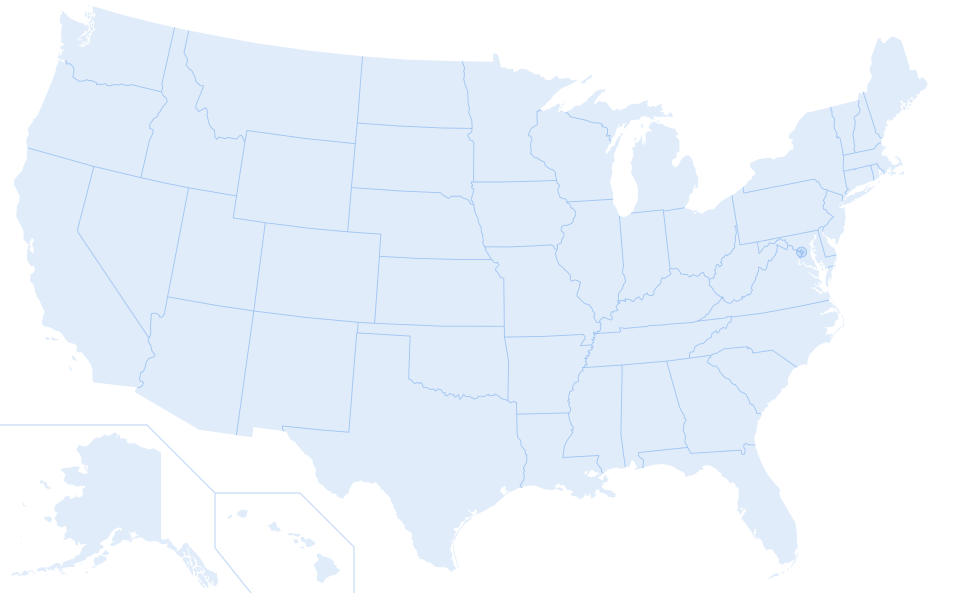
The infrastructure behind CyberNet — carrier-grade engineering since 1995, 150,000+ on-net buildings, 99.999% core uptime, and a US-staffed NOC.
Live network · 10 hubs · 14 backbone links

Network engineering since 1995.
A new generation of customer experience.

CyberNet has spent 31 years designing, deploying, and operating carrier-grade networks across the U.S. The infrastructure is mature, proven, and built to last. What’s new is everything around it, an AI-native experience that turns the way you buy, build, and run your network into a conversation, not a procurement gauntlet.

150,000+ on-net buildings. 700+ cell towers. 99.999% core uptime. One engineering team. One AI.

The Network at a Glance

Building since 1995.
Numbers that hold up to audit.

Every figure below reflects the network we engineer and operate, measured against the standards we deliver to every customer.

31 Years as a licensed CLEC Operating a carrier-grade network since 1995.
150,000+ On-net buildings Reachable on the CyberNet network without third-party loops.
700+ Cell towers served Tower backhaul across the U.S. footprint.
100 Gbps Maximum circuit capacity Per-wave Ethernet, scalable as your business grows.
99.999% Core voice uptime SLA-backed and contractually penalized when missed.
24/7/365 NOC operations US-staffed. Direct engineer line. No tiered escalation maze.
AI-Native Operations

AI doesn’t just sell our network.
It runs our network.

The same NikolAI you talk to when designing your build is the NikolAI watching your circuits the day after they go live. He’s the through-line, from first conversation on this website to the last day you’re a customer. Inside our operations, NikolAI correlates events across thousands of customer environments, surfaces anomalies before they become incidents, and recommends maintenance actions to our engineering team in real time. That’s how a network engineered in 1995 stays current in 2026, and ready for whatever the next decade requires.

  1. 01 Monitor Every circuit, every voice service, every managed asset.
  2. 02 Detect Correlate anomalies across thousands of environments.
  3. 03 Notify Surface in Mission Control before customer impact.
  4. 04 Act Engineer reviews the recommendation. Action taken in real time.
  • Proactive monitoring, not reactive ticketing.

    NikolAI watches every circuit, every voice service, every managed asset. He opens tickets when patterns suggest a problem is forming, before customer impact.

  • Capacity planning that doesn’t wait for failure.

    When a customer site approaches capacity, NikolAI surfaces it in Mission Control with an upgrade path one click away. No more emergency calls after a slowdown.

  • Maintenance that explains itself.

    Planned work gets explained to the customer in plain English, what’s happening, what’s affected, what the alternative is. NikolAI does the translation; the engineer does the work.

The Long View

A network that ages well.
Even when your stack doesn’t.

Most networks are built for today’s workload and retrofitted as the world changes. CyberNet was built around longevity, designed to absorb whatever the next decade of enterprise IT throws at it, from the AI rollout you’re starting this quarter to the edge compute push that’s coming next.

Built for AI workloads

The bandwidth, latency, and geo-redundancy AI deployment actually requires. Real-time inference pulls more from a network than email and SaaS ever did. CyberNet’s capacity ceiling, 100 Gbps per circuit, geo-diverse routing, sub-5ms latency on engineered paths, was overbuilt for yesterday’s traffic and is exactly what AI workloads need today.

Built for compute at the edge

Public cloud egress costs are reshaping where compute lives. Enterprises are pulling workloads back closer to the network edge. CyberNet’s IaaS, virtual desktops, disaster recovery, unlimited computing, uCPE, sits inside our network, peered directly to your circuits. No public-internet hop. No noisy neighbors. No egress surprise on the invoice.

Built to last decades, not quarters

We’ve been laying glass since 1995. The fiber engineered into our network today will still be lit in 2045. That’s the foundation we build every customer architecture on, designed for the workload you have, scalable for the workload you don’t know about yet.

Redundancy Architecture

Three levels of survivability.
Yours to design.

Redundancy isn’t one-size-fits-all. The right level depends on what your business can tolerate when something breaks, and what you’re willing to pay to never find out. We engineer to any of these three postures, and NikolAI will recommend the right one based on your SLA target and workload profile.

01 / Single Path

Single Path

One physical connection per site. Lowest cost. If the path is cut or fails, the site is down until repaired. Typical mean-time-to-repair: 4–24 hours depending on cause and access.

For non-critical operations, secondary sites, and budget-sensitive deployments.
02 / Dual Entrance

Dual Entrance

Two physical connections per site, entering the building from different physical points. Protects against accidental cable cuts, construction damage, or single-point failures at the building edge.

For production business operations where intermittent outages are disruptive.
03 / Geo-Diverse

Geo-Diverse Routing

Two paths that take entirely separate physical routes across separate switching facilities. Protects against regional events, power grid failures, natural disasters, large-scale outages.

For mission-critical environments, healthcare, financial services, and 99.999% SLA targets.
Peering & Interconnect

Direct paths to where
your traffic actually goes.

A carrier is only as fast as its peering. CyberNet maintains direct interconnection at major U.S. internet exchange points and peers with the cloud providers, content networks, and tier-1 backbones your business depends on, which matters more every year as AI workloads pull more traffic through the network.

Cloud Providers
AWS Microsoft Azure Google Cloud Oracle Cloud
Major Exchanges
Equinix CoreSite Digital Realty Any2 · One Wilshire
Content & Transit
Cloudflare Akamai Lumen Tier-1 backbones
24/7/365 Network Operations

NikolAI watches first.
An engineer answers second.

Most carriers route support through a tiered ticketing system. You explain your problem to a level-1 agent, get escalated to a level-2 agent, repeat yourself, get escalated again, and somewhere on the third or fourth handoff a real engineer sees your ticket. CyberNet doesn’t work that way. NikolAI monitors every circuit, every voice service, every managed asset, and opens tickets proactively when something looks wrong, before you call. When human intervention is needed, the call routes directly to an engineer who knows our network, can read our routing tables, and can resolve issues in real time. There is no level-1 layer between you and the person who can fix the problem.

< 60 sec Average call answer time
US-staffed No offshore handoff
Direct engineer line No tiered escalation maze
24/7/365 No holiday closures, no overnight gaps

Full-Stack Engineering

Every layer of the stack —
engineered to one standard.

A carrier network has multiple layers, physical infrastructure, switching and routing, voice core, support operations. Most providers treat each as a separate operational silo. CyberNet engineers them as one integrated system, to a single standard, with one accountable team. That’s what makes the SLAs hold. That’s what makes the NOC effective. And that’s why an outage in one layer doesn’t become a finger-pointing exercise across vendors when something goes wrong.

01 / Physical

Physical Layer

Fiber routes, conduit, and Ethernet circuits engineered for capacity, redundancy, and SLA delivery. Every site is designed against your requirements, bandwidth, hand-off, redundancy posture, and operated under a single architectural standard.

02 / Switching

Switching & Routing

Carrier-grade switching and routing across our POPs. We engineer the topology, manage the protocols, and operate every packet path from hand-off to hand-off. No black-box dependencies between layers.

03 / Voice

Voice Core

A geo-redundant voice platform powering SIP trunking, hosted PBX, PRI, and POTS replacement. 99.999% uptime is a property of how the platform is architected, not a marketing target.

04 / NOC

NOC & Engineering

24/7/365 US-staffed network operations center. Direct line to network engineers, not a tiered ticket queue. When you call, you reach someone who can actually fix the problem.

Compliance-Ready by Design

Audit-ready infrastructure
for regulated industries.

The network was built to support customers in healthcare, finance, education, and government, sectors where compliance isn’t optional and documentation has to hold up to audit. Below: the certifications we operate under, and how the architecture supports the most common compliance needs we encounter.

Compliance & credentials
HIPAA-Ready E-Rate Eligible FCC Part 68 NFPA 72 UL 864 ASME A17.1 SOC 2 Licensed CLEC since 1995 FINRA-CompliantNIST-Aligned
A / Healthcare

HIPAA-Ready Private Networks

Private connectivity, isolated routing, encrypted transport options, and audit-ready logging. Built to support the protected health information requirements of hospital networks, regional clinics, and healthcare campuses.

B / Public Sector

E-Rate Eligible Infrastructure

A licensed CLEC qualified for E-Rate filings. We support school districts and libraries through the application process with procurement-grade documentation and timelines built around the funding window.

C / Life Safety

Life-Safety Certified

POTS replacement and analog services certified to NFPA 72 (alarm monitoring), UL 864 (fire panels), and ASME A17.1 (elevator phones). Fire marshals, inspectors, and insurance auditors recognize our solutions as equivalent or superior to legacy copper.

Transparency Is a Product

Every network you build with us
becomes visible in real time.

The infrastructure on this page, the engineering, the switching, the NOC, the peering, the redundancy, doesn’t sit in a backend you never see. CyberNet’s customer portal, Mission Control, surfaces all of it. You watch your circuit get built from survey to splice to live. You see your sites on a map. You track field technicians in real time. NikolAI surfaces the moments that matter (permit approved, maintenance window opening, capacity threshold crossed) before you ever have to ask. Every CyberNet engagement includes Mission Control. It’s how a 31-year network becomes a 25-second answer to “where’s my build right now?”

See how Mission Control works
Put the Network to Work

Ready to design something on it?
Start the conversation.

The infrastructure on this page exists to be built on. Tell us what you’re trying to do, connect sites, replace a current carrier, modernize voice, host workloads, and we’ll come back with an engineered proposal. No SDR layer. No discovery scripts. A senior network engineer reviews your design and responds within one business day.

Common questions

Common questions

How long has CyberNet been operating?

CyberNet has been a licensed CLEC since 1995, engineering carrier networks for 31 years.

How large is the network?

150,000+ on-net buildings and 700+ cell towers, with a 99.999% core-uptime SLA.

Is the NOC in-house?

Yes. A US-staffed NOC operating 24/7/365, with a direct line to a network engineer and no level-1 layer in between.

How is CyberNet different from other carriers?

CyberNet is an engineering-led, licensed CLEC since 1995 that owns its network, 150,000+ on-net buildings and 700+ cell towers. You work directly with the engineers who design and run your service, with no level-1 layer between you and the person who can fix the problem.

What uptime does CyberNet commit to?

A 99.999% core-uptime SLA, contractually penalized when missed.

How quickly will I hear back?

Within one business day.